Tuesday, August 11, 2020

Designing for the Future of Work During Covid19

Solidarity and A.I. for Transitioning to Crowd Work during COVID-19 from Saiph Savage on Vimeo.


 Last week, my research was featured in Microsoft's New Future of Work Symposium. I also helped chair a few sessions. The goal of the symposium was to provide an open forum to explore: where the future of work should go towards, especially given the changes the COVID-19 pandemic has brought.


 Below  I present a brief summary of some of the sessions I attended in the symposium: 


🌟 Highlighted Talks: Gig Work, VR, & Disabilities.

My research was featured in this set of highlighted talks. Sean Rintel from Microsoft was our chair. 
 
Some of the talks included:

Joshua McVeigh-Schultz & Katherine Isbister, SFSU and UC Santa Cruz, VR in Workplace Meetings: Learning from Social VR in ‘The Wild’

This talk discussed the ways in which VR could be used to improve work environments. I found particularly interesting the notion of how surreal animals (such as gigantic cats, similar to the ones in Alice in Wonderland) could be integrated into the work place to provoke conversations and interactions that might not be possible with traditional labor.  This research in general is exploring how VR can create labor interactions we might not be able to have under traditional settings. However, here it is also important to think about how do we avoid turning the workspace into an amusement park . How might we still maintain the seriousness and professionalism that some employers and workers might value?  Other related questions that emerged for this work, was about how integrating VR might create a large cognitive load on workers, especially when they had to switch contexts (e.g., they are working from home and engaging in a virtual environment and meeting with their boss, but now they have to switch contexts and check on their toddler that exists just in the real world.) It is important to also consider how these technologies might make it easier for workers to switch between the different activities they do in their labor, but also in their personal lives.

This research in general falls under the areas of serious games. My research lab has also been exploring storytelling and games in crowd work. Especially how we could integrate play as a tangent activity into online labor. Below some examples of our play in crowd work research:


Figure 2. A storyboard discussion prompt for speed-dating. 
Figure 1. Turker Tales interface: Top panel shows a Turker-created scenario another Turker could see during a categorization HIT. Lower panel shows the message and GIF they see upon completing the HIT.
 
 
John Tang, Microsoft, Early Indicators of the Effect of the Global Shift to Remote Work on People with Disabilities.

This research from Microsoft was exploring the ways that the pandemic was affecting the work of people with disabilities. One of the things I found interesting from this talk was that the work found that for people with disabilities one of the biggest challenges they faced was having to put on their cameras during meetings. Having to turn on their cameras was hard because many times this meant that the person with disabilities would have to "perform" for the people on the call (e.g., ensure they keep a certain posture in front of the camera, look a certain way), in addition to paying attention to what each person said and contributed (which was more difficult in a mediated communication settings, because the audio could be more noisy than meeting in person, or they might not have as clear an image of the people speaking to make out what they were saying)  Additionally, many times people with disabilities had interpreters who were the ones who ended up interacting with their co-workers for them. Given that algorithms sometimes highlight the people who participate and interact with others, the people with disabilities felt left out of the conversation, erased (as the algorithms would never showcase them within the chat and video interfaces). I found this talk thought provoking and it helped me to start to think about how the technology we have and norms we establish (such as forcing everyone in a meeting to turn on their cameras), can create power struggles, especially put people with disabilities in a position where they are erased from conversations, and also are given additional cognitive loads.

Saiph Savage & Mohammad Jarrahi, Microsoft and UNC Chapel Hill. Solidarity and A.I. for Transitioning to Crowd Work during COVID-19 
Our research focused on combining worker solidarity and A.I. to design the future of work after COVID-19. Our video  isshown on top of this post:

Due to the COVID-19 pandemic, a number of gig workers who engaged in location-based gig work (e.g., Taskrabbit, Care.com, or Wag) have had to transition to new jobs that are independent of location (e.g., online freelancing or crowd work). However, this has been a difficult transition. Especially because in this new environment, gig workers now have to compete globally for work, and they also have to focus on work interactions that are primarily online (instead of gig work that takes place within specific physical locations or within in-person meetings). In this paper, we build on our extensive research on gig work, gig literacy and the design of crowdsourcing systems, to present an intelligent architecture for helping workers transition to new gig jobs in times of global crisis. Our intelligent architecture uses machine learning and draws on collective action theory to introduce ``Solidarity Brokers.'' Our Solidarity Brokers are computational mechanisms that identify the best ways to build solidarity between workers with the purpose of mobilizing workers to help each other transition to new jobs. We finish by presenting a brief research agenda for intelligent tools that facilitate work transitions during the global pandemic and beyond.

Next, I co-chaired with Professor Steven B Sawyer the break out session of: 

✨"Employment: Hiring, onboarding, management, freelancing, on-demand, crowdwork, gig work" 

Some interesting things that were discussed here was that:
    • Instcart during the pandemic has been pushing a narrative of "The gig workers on this platform are heroes!" However, not all Instacart workers are buying this narrative of seeing themselves as heroes. They are bothered that the company is not doing more to keep workers safe. The narrative feels manipulative, especially when the workers are out risking their health just so somebody else can eat an ice-cream. Workers feel they are not getting essential food, but rather  "buying the indulgences of an elite".

      • Interesting to  learn how gig workers are identifying what tasks are "essential" and which ones are more "indulgence".

      • It is important to consider how these hero narratives will change over time and whether they will have any long-lasting effects on how we view these gig workers.

    •  Instacart workers tend to be more white women. I found this interesting given that a large portion of gig workers are usually people of color. However, on Instacart white women workers  might be more present because they need a car to be able to buy groceries. White women usually are better off economically than women of color and hence they can  more likely better afford to have their own car to work on the platform and buy groceries. Notice that Uber/Lyft also requires that you have a car. But, markets have emerged where people can rent cars to work on Uber/Lyft. Instacart is still not as popular so these  markets are not yet available.

    • There were also discussions around how do we design worker centric platforms during the pandemic, especially for location based gig work and location independent gig work. Example of Location Independent include: Upwork, Amazon Mechanical Turk; while Location-Dependent includes Instacart, Uber/Lyft, Task Rabbit. 
    • We also discussed  how the learning curves that gig platforms have can also act as a barrier for helping workers grow and transition to different jobs across gig markets. People who are established on certain platforms like Upwork might have a harder time moving to other platforms like Fiverr, etc where they have to rebuild their reputation. These type of dynamics affect workers' empowerment and where they can move to.
    • There was also discussions on whether the process of designing for the worker can align incentives for all parties (platform, workers, customers) or whether it would entail concentrating power between two stakeholders (e.g., customers and workers) to "overthrow" the unfair practices of the platform. It is not clear which approach is more promising, or what are the alternatives?

      There were a lot of reference's to Michael Dunn's research where he studied the characteristics of the different gig markets. We discussed his characterization to start to think about how these properties might be best leveraged to create worker centric labor platforms during the pandemic and beyond. Below some nice images of the work Michael Dunn has done in this space to characterize different gig markets.


Finally, I also co-chaired with Frank Morgan the session of:


    •  


✨"Society: Public policy, business, economics, health, societal implications and confounding factors"

Here we had discussions around:
  •  How might we be able to measure competency and available potential of a workforce in the wild? An issue that can emerge is that it is not straightforward to know what are the best ways to visualize competency and potential. It can depend on the strategy  and the type of work a company wants to get done. 
  • Social Glue. Having workers keep social interactions with each other can help them to get work done  (they need social glue.) However, we discussed whether this social glue was also needed within crowd work. The group argued that since crowd work had primarily micro labor, social glue was not needed. Workers were transient. However, based on my lab's research around crowd work, I would argue that social glue is very necessary in crowd work as well. Primarily because: crowd work also has a steep learning curve. Therefore, the workers that stay on the platform are the ones who have invested significant time in learning how to find good work, and learning best practices for getting that work done to ensure quality and high wages for themselves. Crowd  workers are not transient. Considering that these workers will spend significant time on Amazon Mechanical Turk, and other crowd platforms, it can be important to think about how might we facilitate empowering workers within this space. I would argue that it is through the social glue. Through creating solidarity between workers. My lab's CSCW paper explored this angle of helping workers keep social glue through peer coaching.
  • How might we design technology to make workers more productive and flexible, what kinds of policies should we create to ensure that a diverse set of workers benefit from productivity and flexibility? For example, could we use breaks and work disruptions as mechanisms to help workers relaxed or further connected with their children? What kind of social divisions are new technologies creating in workers? (Some workers can access highly specialized tools because they can afford them, while other cannot. What type of divisions and gaps does this cause? ) Alex Williams has an interesting paper looking at tooling and how it can further create social divisions in crowd workers.  
     
     
    Overall, I greatly enjoyed having discussions around the Future of Work with Microsoft, other academics and different folks for industry. It was motivating to brainstorm  together to start defining an empowering future of work 👊

Sunday, November 17, 2019

Artificial Intelligence and Work:
AAAI 2019 Fall Symposium

Last week I attended the AAAI 2019 Fall Symposium on Artificial Intelligence and Work. The purpose of the two and one-half day symposium in Washington, DC, USA was to collectively create an action plan on how Artificial Intelligence (AI) could contribute to the Future of Work. There has been several conversations about Artificial Intelligence and how it is displacing people from their jobs. Our goal was to shift these conversations and re-think how AI might be used to empower workers. Our workshop was organized by the awesome Larry Medsker and Kevin Crowston.


For this purpose, we first had a series of talks from scholars all over the country who presented on how they are using AI for the Future of Work. We then had discussions on each of these talks, and created teams to collectively work on potential NSF proposals that addressed interesting angles of these talks. I (Saiph) personally gave a talk on how artificial intelligence could be used to help workers produce collective action and build the societies they envision. The slides from my talk are here: Slides.

A few of the other talks included:
*Algorithmic Management and Algorithmic Competencies: Understanding and Appropriating Algorithms in Gig work.
This talk was given by Prof Mohammad Hossein Jarrahi. The talk discussed how algorithms were managing gig workers and how this was leading workers to adopt creative ways of playing the algorithms to gain agency. For instance, Upwork does not allow workers to post their first names to control workers getting visibility outside the platform (e.g., a potential employer might search for them on Bing, find their website or email, and hence end up contacting and hiring them outside Upwork, which is a threat to Upwork as they would not get commissions.) To overcome this problem, workers use social media creatively to engage their potential employers outside the platforms and facilitate that they do find them. Prof Mohammad Hossein Jarrahi talked about the importance of facilitating tools for gig workers that could operate cross gig markets (a type of META-tools that could help workers to manage themselves as they work and operate in different gig markets.)

*Modeling the Future of Workforce Development in the Age of AI.
This talk was given by Prof. Ellen Scully-Russ who discussed how Artificial Intelligence is creating situations where a lot of workers are being left behind. The problem is also that if you can't enter into a lower wage labor market your chances of entering into another career is even lower. Professor Scully-Russ questions then, how do people enter the workforce? The lower level jobs are being taken by machines. The workers who would normally join at the lower level and then scale their way up, now can no longer even join the workforce. What can we do about this situation? This problem is especially aggravated with people of color (Latinos and Blacks are the populations who have the most jobs that have the risk of being automated. When thinking about strategies to address the Future of Work, we need to consider workforce planning models that can take into account that certain entry jobs might be removed, and there is therefore a need to think about plans for inserting people in workforce levels that are higher than what they would normally enter. Another problem that Prof. Ellen Scully-Russ discussed is that workplaces across the world are integrating Artificial Intelligence into their operation. But, we currently do not have a clear idea of how this is affecting people's work, how it is affecting workers, or the overall effect of integrating such technology. We need to think about the best ways in which the community could share results and collectively derive design principles on AI and work.

We also had a great talk from NSF program director Dr. Stephanie Elizabeth August who provided an overview of how NSF views the Future of Work with Artificial Intelligence. NSF is investing 8.1 billion dollars on Artificial Intelligence research. In specific, NSF plans to invest in the creation of centers through which different institutions can work with each other (sharing code, research, data, infrastructure.) In this space, NSF also plans to support research in the domain of work. For this purpose, NSF has created the program of Future of Work at the Human-Technology Frontier: Core Research (FW-HTF). This program focuses on funding research proposals in the domain of work that would not be funded by other solicitations. Most importantly the solicitations for the Future of Work need to consider the three areas of: technlogy for work, the life of the worker, and the context of work. You need to have research questions for these three areas.


Overall, I really enjoyed the symposium and felt excited about building and transforming the future of work.

Friday, September 04, 2015

Tag Me Maybe?  Maintaining Friendships and Influencing Algorithms


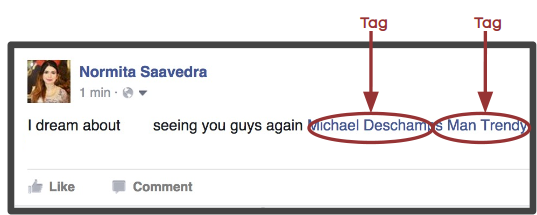
[Caption: Example of Facebook Post with People tagged.]

With the “@” sign, we are now able to include others in our lives more easily. Tagging or mentioning people in content lets you share the story with someone in front of everyone, demonstrating publicly both your friendship and the shared interests that created it. We did interviews with 120 participants to uncover perceptions on tagging people.

Tagging To Build Stronger Relationships.


Most (79%) saw tagging as a way to build strong relationships, citing: “it made people feel special to have someone making time for them to tag them.” Tagged posts generated automatically by companies were not perceived as positively, because people did not connect them with genuine human connections. As designers we need to help companies better engage with their online clients, one option being encouraging more humanized interactions. The discussion matters given the recent lawsuit over people’s names appearing in tagged ads.

Tagging to influence Facebook’s algorithms, and distribute more surprising content.


Our interviewees (61%) saw tagging as a way to expose audiences to information outside of what they saw on Facebook. There was a notion that Facebook showed to friends a same type of content. Tagging broke this by letting people reach new social graphs at once (e.g., the friends of the taggees), and share with them information outside their norm. One woman, said, “I like to tag people that I know are interested in something and whose audience will also care. But my interest is in creating a crossover. So I involve audiences that follow people in dance, but I share with them something totally different, such as poetry.” 

Another, told a folk story of how tags influenced Facebook’s algorithms and helped give her content more viewers, “If I tag someone and then he comments, the post becomes ‘active’ and it’ll appear at the top of the News Feed. So I’ll sometimes tag someone directly in the post or in the comments. In either case, if it makes him comment, the post will be pushed to the top.”

Recommendation algorithms have tried to filter opinions, people and items that are different to us, limiting the diffusion of information. Our study highlights how people appear to value “things outside the norm”. Our interviewees had a need to distribute fresh information that could free audiences from algorithmic biases. Our research on tagging thus raises the question — would social media benefit from more official digital structures tailored for targeting new audiences and sharing with them strange information? Audiences could be bombarded with more unwanted content, but it could also facilitate “serendipitous” discoveries. 

To read more, checkout our Hyptertext 2015 research paper:
Tag me Maybe: Perceptions of Public Targeted Sharing on Facebook,
with Saiph Savage, Andres Monroy-Hernandez, Kasturi Bhattacharjee, Tobias Hollerer.


Tuesday, March 31, 2015

#FixIT@UNAM: How We Got Over A Hundred Latinas In Our Hackathon


[Image Caption: Group photo of #FixIT: Latina Hackathon @ UNAM

[Image Caption: #FixIT was a success because we worked with the community to 
make Latinas feel welcomed] 


Highlights

  • Organized  a large scale Latina Hackathon #FixIT with almost 300 registered females and 147 female Hackers on February 26-27 2015 at the National Autonomous University of Mexico (UNAM).
  • The Hackathon had a large female turnout because we created a space welcoming for Latinas.
  •  Hackers designed innovative smart home appliances using arduinos, and collaborated with other very diverse females, such as high school students, young professionals, graduate and undergraduates in Computer Engineering, Mechatronics, Industrial Design, Philosophy, Politial Science, among others.
  • The Hackathon's organization  had powerful team work between Google Anita Borg Scholars, US and Mexican universities (UNAM, UCSB, UC Berkeley, UCD, Georgia Tech) and non-profits (Major League Hacking, SocialTIC).


Many organizations have been fighting to bring diversity into IT. But it has been a sloooow loooong progress. I don't like slow! I decided to take things into my own hands :) So I did what you always do when you’re a little guy facing a terrible future with long odds and little hope of success: I teamed up with my friends.

I was very fortunate to have been awarded to join the planning committee of Google Anita Borg Scholars. This new organization has the mission to increment world-wide the number of women participating in computer science. I started to work closely with Miray Kas, and Sarah Safir. These two women gave me the motivation and inspiration to start dreaming and making a reality: the idea of Fixing IT, rapidly bringing diversity. It gave me the drive to stay up multiple nights with friends further devising a plan.

Online I got introduced to many new great people, from other Googlers who had careers focused in fostering diversity, to 19 year old UNAM students, like Juan Pablo Flores, who organized large scale Hackathons throughout their country. I’ve worked with some of the strongest teams in industry, academia, and even sport (Olympic medalists!) But I’ve never seen anything like this.
Starting from literally nothing, we went to having a fast moving plan: We would do a Hackathon! A female Hackathon, a Latina Hackathon. We would be fighting to incorporate two minorities at once!

[Image Caption: Latinas in 
#FixIT hacking away.]

Why a Hackathon?
We saw Hackathons as a fast way to turn anyone into creators, not just consumers of, technology. We wanted to create a space that would empower these minorities to build and present their own visions of what technology looks like.

We were a strong motivated team, but in a certain sense we were also just newbies, running around telling everyone we were going to create this new awesome more inclusive hackathon. You can ask anyone, I was constantly inviting everyone to join and participate in my Hackathon. The problem was that we didn't really know any latinas interested in tech; we didn't have a space to hold the Hackathon. Heck, we didn't even have a budget. We had no funds to even run it.  Even I began to doubt myself. It was a rough period.

But December hit and suddenly things started moving.  Suddenly all the work we had done started coming together. All the folks we talked  to about it suddenly began getting really involved and getting others involved. Everything started snowballing. It happened so fast.

So... How did we make it happen?


[Image Caption: UNAM Professors helping to explain Hackathon dynamics.
The professors helped to secure the spaces, 
prepare bootcamps, and connect with students.]


A. Professors from the National Autonomous University of Mexico (UNAM) got involved.
[Note that UNAM is one of the largest public universities in the world, and also one with  high academic ranking] The professors played a key role in the Hackathon's success because they helped us secure a space where we could run the Hackathon. From interviews with latinas we found that: 1) some latinas did not attend Hackathons because they lacked their own equipment; 2)  some parents from latinas only allowed their daughters to  participate in  the Hackathon if it happened during the school week and it was part of a school activity; 3) some Latinas felt insecure of their technical skills and this made them hide away from hackathons
This lead us to want  to create a Hackathon that covered the needs of these girls, and made it easy for them to participate.
1. The UNAM professors helped us secure computer labs so that participants would not need to bring their own equipment.

2. The professors also gave us access to their network of high school and college professors (UNAM also has high schools!) These professors kindly invited their Latina students to our event; many physically drove them there; and some even turned it into an official school activity.

[Image Caption: Latinas with Mentors
@ #FixIT bootcamp.]


3. The UNAM professors and also UNAM senior students helped us to prepare a bootcamp. We felt the bootcamp would give participants more security in themselves and help them thrive. The bootcamps helped participants regardless of their programming knowledge or skill to start designing and building smart houses using Arduino. UNAM also gave us many mentors  that helped participants throughout the hackathon. These mentors were very engaged students that also helped to create security in participants.

From interviews, we also suddenly realized that this might be one of the first large scale latina Hackathon in the region. It then made sense to try to help participants to build a network, and inspire and help each other to succeed. We thus decided to have talks for the Hackathon. Female professors, such as Dr. Cindy Rubio from UC Davis,  and graduate students, such as Deana Brown from Georgia Tech. They  all came down to UNAM to give inspiring talks on their research, career paths, and how they managed to succeed. Here again the UNAM professors managed to secure for us a large auditorium for the talks.
**For all of this thanks to Prof. Norma Elva Chavez and Dr. Jesus Savage. 


B. Amazing Google Anita Borg Scholars Support
The network of Google Anita Borg Scholars, specifically Miray Kas,  connected me with a group of very passionate Googlers, e.g., Rohan Lamba,  who had the vision of creating large scale hackathons across the world. The group helped cover all of the costs of the hackathon, and helped immensely with the planning and logistics. Rohan also came to the hackathon at UNAM and was up with me since 4 am the day of the Hackathon planning and hacking away!  Thanks to Google, our Hackathon gave participants:

1) Awesome Swag (Tshirts, bags, stickers, Tech Girls are Superheroes book! **This was actually written and created by another Google Anita Borg Scholar, Jenine Beekhuyzen!)
2) Kits to build and design Smart Houses using arduino.
3) Lots of great delicious Mexican food!
4)Awesome Prizes! (This was important to motivate participants. )

The Google Anita Borg Scholar network also gave us inspiring speakers and mentors. Both Dr. Cindy Rubio and Deana Brown were Anita Borg Scholars. They came down to UNAM to give inspiring strong talks.

[Image Caption: Dr. Cindy Rubio was the
keynote speaker of #FixIT]


C. Awesome UNAM Students
Our Hackathon had a large turnout, perhaps one of the largest Latina Hackathons to date. How did this happen? I believe it helped us immensely to listen to the needs of these young latinas. Undergraduate students from UNAM connected us with large networks of females who explained to us what it would take to have them attend the hackathon. We created spaces that facilitated their participation and they came! We had participation from schools and universities across the globe. Some examples were Universidad nacional Autonoma de Mexico (UNAM); Instituto Politecnico Nacional (IPN);  ITAM; Tec de Monterrey; Georgia Tech; University of California Santa Barbara, UC Berkeley; UC Davis; Oxford.

The biggest takeaway from this is that perhaps the success of our Hackathon came not necessarily because we had big tech players on our side. We succeed because there was this enormous mental shift in the students, professors, and just everyone involved. All of them were thinking of ways they could help to recruit and bring their latina friends to our event. Often really clever, ingenious ways. Students made videos. They designed ads. They bought billboards. They announced massively and repeatedly on social media. They had rallies. Students saw it as their responsibility to help.
Here a big shoutout to Juan Pablo Flores, Alejandra Monroy!


D. The Designers
Laura Ballroom and Ariadna Gómez Dessavre were the designers of the Hackathon. Ari made the awesome #FixIT logo; and Laura designed the tshirts, stickers and certificates.


The designers were key for the event because they created products that were used and adopted by participants. This helped to create a collective identity for the event and build a community. I loved seeing on social media people share selfies with their Hackathon tshirts and feel proud to wear them.

I loved seeing the senior female student add our sticker to her laptop (along with the multiple other stickers she proudly shows to present all the tech events she has attend) and the young high school student add our sticker to her bare laptop (representing this is her first tech events. But seems to be likely to attend now more :)


I believe we won this fight, we were able to have a hackathon with hundreds of latinas; rapidly bringing diversity into technology, because everyone made themselves the hero of their own story. Everyone took it as their job to have an event where more audiences could be included; where more voices could be empowered to design and construct technology. They threw themselves into it. They did whatever they could think of to do. They didn’t stop to ask anyone for permission.

We, the people decided to make a difference. We decided to make it our responsibility to do this work. To change who is empowered to participate in a Hackathon. Who is empowered to define technology. Let's not forget that we do have the power to change our reality.
"Juntas Creando y Transformando la Realidad"
[This was the main quote for #FixIT, it reads in Spanish: Together Creating and Transforming Reality]


[Image Caption: #FixIT was a success because we worked with the community to 
make Latinas feel welcomed] 


This text is a remix of Aaron Swartz's inspiring speech: How we Stopped SOPA." We miss you Aaron. 

Monday, November 17, 2014

Visualizing Online Audiences


         Caption: Social Spread Interface lets people select audiences based on their social connections

We tend to think that the larger our online audience, the more comments and interactions our content will receive. Yet this is not always the case.

The presence of other people can create a diffusion of responsibility. People don't feel as pressured to take action when they feel they share responsibility with others. Paradoxically, when someone poses a question to her entire  network, her friends are less likely to respond than if she made the question to a small targeted audience. Directing content to specific groups of people can help users harvest richer online interactions.

Many tech-savvy users  use different sharing mechanisms to engage in selective sharing, directing content  to specific predefined audiences. These users usually define list of people with particular interests or social ties (e.g., coworkers.) They then post content contextualized so that it is relevant to the interests of the people in each list.
But, keeping up-to-date lists can be hard and time-consuming. It's also inapplicable for more dynamic interactions, based on location, or popularity of the targeted users. For example,  someone organizing a social rally might only want to target the friends who are in town on a particular day. Or a person who just wrote an article on Gay rights might want the help from their most  influential friends in the topic to promote their article.
Another technique involves selecting individuals to target on-the-fly and only sharing the content or message to them. This type of behavior allows for a more dynamic selective sharing experience that is context-driven. This practice is usually referred to as targeted sharing.

Finding the right people at the right time is hard, especially when we are interacting in large communities where it is hard to keep track of everyone's interests and traits. Previous work, including Facebook's graph search, used list-based interfaces to recommend people with a certain expertise, interest or trait. But these systems do not let people easily explore and compare the different characteristics of the recommended individuals. However, these characteristics can play an important role when people are deciding whether or not to select a person for a particular collaboration or interaction. People want ways through which they can understand the space of users they can target to interact. List based interfaces don't let people have quick overviews of their possible targeted audience. Nor do they let people easily zoom in and compare specific users. But to have rich sharing experiences people need to understand their audience: an overview and its details. For instance, a person wanting to post on LGBT might need to understand that half of her interested audience is from Russia. This might mean that to better engage with them, she should include some LGBT issues happening in their country.

 Interactive visualization tools can enable effective audience targeting by prompting a user to learn about their audience and to understand their different interests. To explore these ideas, we designed Hax. Hax is a tool that provides a query interface and multiple visualizations to support users in dynamically choosing audiences for their targeted sharing tasks. We study how users engaged with this tool in the context of sharing and connecting with an audience on Facebook.

 We believe the data modeling techniques that work for content categorization and information retrieval can be adapted to mine people's interests and retrieve audiences relevant to users' diverse needs. But, while specialized data modeling algorithms exist that can correctly categorize data, they rarely fully capture the complex and ever-changing decision-making process for targeting an audience. We therefore opt to integrate data visualizations that incorporate a human-in-the-loop approach. We designed different data visualizations that highlight specific traits, or social signals, of relevant individuals in order to aid users in their audience targeting tasks.

Our exploration begins with the three social signals listed below. We briefly define the signal and the reasons for considering it. We decided to begin with these signals as previous work identified they play an important role in targeting audiences:

Shared interests: This signal captures the personal thematic interests of each community member. Many researchers and practitioners view collaborations as a process that aggregates personal interests into collective choices through self-interested bargaining. We believe this bargaining process can be facilitated by making users aware of the personal interests of others, and how they relate to the collaboration task they are promoting.

 Location: This signal holds information about the countries, states, and cities where community members live. Collaborations supported by computers have traditionally provided users with the luxury of interacting with others without having to worry about their location. However, location does play an important role when interacting and organizing events within the physical world (e.g., a social rally) as others' spatial-temporal constraints can determine how mucha person will engage in the activity.

Social Spread: This signal holds information about the type of friends and social ties community members have. This signal is important because it can aid members in recognizing prospective newcomers who can help keep the community alive and active. Additionally, the social connections of a member can also help in the spread of the community's messages and visions. Members could thus use this signal to identify the users whose social connectivity would help them the most in distributing certain content.

      Caption: Zoomed in Version of our Location Based Interface (top,) Transparent Interface (middle,) and Social Spread (bottom)

For more, see our full paper to be presented at COOP2014,  Visualizing Targeted Audiences co-authored by Saiph Savage, Angus Forbes, Carlos Toxtli, Grant McKenzie, and Shloka Desai

Monday, October 14, 2013

You know that thing I used to hate?...I love it now!: Expert Evolution in Social Media

It took me a long time to really appreciate some of the most successful people that have ever lived, such as Steve Jobs or Coco Chanel. Despite the adversity of being born orphans, these individuals changed their reality and transformed the world that we know.

Have you ever felt that one same thing, can have various different meanings in different points of your life? For example, I used to dislike Apple products, due to their closed architecture, lack of customization, all the related Steve Jobs fanboys etc. Now my opinion has shifted, and I am considering purchasing a macbook pro.

This paper: "From Amateurs to Connoisseurs: Modeling the Evolution of User Expertise through Online Reviews" from www2013, models precisely how users' perceptions on products (particularly beer!) change through time. Note that perceptions can be compared to level of expertise.
The work considers that users evolve on their own "personal clock" (i.e., each user is modelled on its own time-scale.)  so some users may be really experienced when they provide their first review, while other users may  never ever become experts. It is also assumed, that users with similar levels of expertise will rate products in similar ways, even if their ratings are temporally far apart, e.g., a user  from 2013 will rate things similarly to a user from 1999, if both users are in the same "noob level" (note that what will remain constant throughout time is what the "noob level" means.)

The work models the level of experience of each user as  a series of latent parameters that are constrained to be monotonically non-decreasing as a function of time. Therefore users can only become more experienced (or stay at least at the same level of experience...this clearly does not consider cases related to the German word of "Verlernen," where you forget something you have already learned!) Users evolve as they rate more products, i.e. the work considers that the very act of consuming products will cause users' tastes to change.
In particular the authors consider that users move from one level of expertise  to another, depending  on how they rate particular products.  Given that the paper works with a beer rating dataset, the authors consider that expert users will rate higher the hoppiest beers, i.e. the strong Ales  (confused what hops in beer mean, check this article out.) It is assumed that liking strong Ales is an acquired taste.
The figure below shows the ratings different users have given to different beers. We see how the Firestone XV, a strong ale,  is one of the beer that was rated the highest, and they consider this corresponds to an expert rating.  The figure also shows how biases can exist for different beers given the level of expertise of the user.

The approach is somewhat simple, different recommender systems are created for different stages of user evolution.
A classic latent factor recommender system would look something like the following: 

The authors create a sort of feature vector, that has different recommender systems for each stage of the user's life cycle:


Latent factor recommender models, are a collaborative filtering type recommendation algorithms, which consider that for specific domains (e.g., action films or beer) there exits a set of factors that influence the rating a specific item receives. These factors are not obvious, and it is difficult to predict the actual impact they have on  a rating.
The first goal of the latent factor recommender models is to infer these latent factors from the data by using mathematical techniques. 

In the author's approach it is considered that users that have a certain experience level will be influenced by certain type of factors in their rating. So e.g., a novice user the fact that a certain beer is more inexpensive than another might play a big role in how much the user says to like the beer, but for a more experiencied user,  he might be more influenced by the beer's texture. This is why the authors consider different recommender models for each experience level of the user.

Latent Factor models map users and items into a latent feature space.
A user's feature vector denotes the user's affinity to each of the features.  The product or item's feature vector represents how much the item itself  is related to the features. A rating is approximated  by the dot product of the user feature vector and the item feature vector.
 Specifically, consider that we have  a set U of users, and a set D of items. Let \mathbf{R} of size |U| \times |D| be the matrix that contains all the ratings that the users have given to the items.
The first task of this method is to discover the  $K$ latent features. At the end of the day,  we want to find two matrics matrices U (a |U| \times K matrix) and M (a |D| \times K matrix) such that their product approximates \mathbf{R}:

  The following image shows how the rating of items is composed of the dot product of matrices with these feature vectors:

Note that the M transposed matrix corresponds to the feature vectors of items.
Each row of U  represents the strength of the associations between a user and the features. Similarly, each row of M represents the strength of the associations between an item and the features. To get the prediction of a rating of an item d_j by u_i, we  calculate the dot product of the two vectors corresponding to u_i and d_j:


\hat{r}_{ij} = p_i^T q_j = \sum_{k=1}^k{p_{ik}q_{kj}}


The task is now to obtain U and M. One common way to approach this problem is the first intialize the two matrices with some values, calculate how `different’ their product is to R, and then try to minimize this difference iteratively. This method is called gradient descent. Its purpose is find a local minimum of the difference.
This difference is usually called the error between the estimated rating and the real rating, can be calculated by the following equation for each user-item pair:

e_{ij}^2 = (r_{ij} - \hat{r}_{ij})^2 = (r_{ij} - \sum_{k=1}^K{p_{ik}q_{kj}})^2

The squared error is considered because the estimated rating can be either higher or lower than the real rating.
To minimize the error, we need to know in which direction we have to modify the values of p_{ik} and q_{kj}. In other words, we need to know the gradient at the current values. Thus  we differentiate the above equation with respect to these two variables separately:


\frac{\partial}{\partial p_{ik}}e_{ij}^2 = -2(r_{ij} - \hat{r}_{ij})(q_{kj}) = -2 e_{ij} q_{kj}
  \frac{\partial}{\partial q_{ik}}e_{ij}^2 = -2(r_{ij} - \hat{r}_{ij})(p_{ik}) = -2 e_{ij} p_{ik}

With the gradient,  the update rules for both p_{ik} and q_{kj} can be formulated as:


p'_{ik} = p_{ik} + \alpha \frac{\partial}{\partial p_{ik}}e_{ij}^2 = p_{ik} + 2\alpha e_{ij} q_{kj}
q'_{kj} = q_{kj} + \alpha \frac{\partial}{\partial q_{kj}}e_{ij}^2 = q_{kj} + 2\alpha e_{ij} p_{ik}

\alpha is a constant that helps determine the rate of approaching the minimum. Usually  the value of \alpha  is small to avoid the risk of missing the minimum and oscillating around the minimum.

Ok...
Now that latent factor models are clear (hopefully)...let's get back to the author's problem.
As we mentioned previously, the authors consider that  for each evolution stage of a user, there will be a recommender system that can adequtly capture the user's taste at that point in his life.
So their problem comes down to:
-Fitting the parameters of their recommender system.
-Fit the user's experience progression (i.e., be able to state that when the author reviewed X item, they were at a certain experience rate.)

Note that once we know the experience level in which all users contributed each of their reviews, fitting the parameters of each recommender model is a snitch (it's basically the same procedure experienced for classic latent factor recommendations.)

The question now is, how do we fit the user's experience progression? Well if we assume that users gain experience monotonically, as they rate more products, we  can fit experience using dynamic programming.


The two steps (fitting each user's experience level, and fitting the parameters of each recommender ) are repeated until conversion.


Sunday, June 16, 2013

Studying the Thesis of PhD Heroes: Munmun De Choudhury

Given that I am in the process of beginning to write my PhD thesis, I am currently reviewing the PhD thesis of doctors that have been more than successful in their career; these are people I admire and find inspirational for my own PhD path: my PhD heroes.
I have decided to create blog posts that describe some of the main contributions that these PhD thesis had, the new ways of thinking that these doctors brought in. I will begin this series with the PhD dissertation of Munmun De Choudhury, currently working in Microsoft research; she has several publications in top conferences such as CSCW, CHI, ICWSM, WWW, among others. Munmun is indeed one of my main true PhD heroes.

 Her thesis focused on designing frameworks and computational models to obtain a detailed understanding of how communication happens in online social networks. It was considered that online communication patterns are divided  in two main forms: the actual message discussed, and the channel or media used to discuss the message.  Work before Dr. De Choudhury's thesis focused  more on studying the network structure and dynamics, and little emphasis was given to providing tools that could characterize the type of messages present in an online community, providing insightful  observational studies on large-scale social communication datasets.

In particular, her research explored 3 main areas: (1) how information is diffused in an online social network, analyzing in particular how the influence of users and the fact that you can have very many similar users talking to each other, affects information spread; (2) how communication dynamics in online communities can be modeled, particularly focused on external and internal communication factors; (3) how "interestingness" of conversations can be modeled and measured , in particular focusing on detecting interesting conversations and identifying the features that turn them into interesting content.

Providing means to explore and analyze what are the dynamics and impact of our online social communications is important because social media data has shown to originate and create real world revolutions, think e.g., elections in Iran, Earthquake in Haiti. Social media also enables viral marketing, enabling collaborations in corporations, and can help users find experts, or even people that can help them connect with others.

In the following we begin exploring in detail each of the main themes discussed in her thesis.

Measuring the Intrestingness of a Conversation: The work considered that a conversation was interesting, when it made participants return to the conversation and continue commenting and posting. Such behavior is observed frequently on youtube, when users have already watched the video, yet they are returning to the video to comment and respond to others.
The work considered that people will participate and return to conversation when the theme of the conversation is engaging and/or interesting people are participating in the discussion. They predicted that users will return to a conversation, when they:  (a)  find the whole conversation theme interesting;  (b) see comments by people that are well known in the community; (c) observe an engaging dialogue between two or more people (an absorbing back and forth between two people).
Additionally conversations that are interesting will be propagated throughout the network; we will observe things like: users will seek other users who participated in interesting conversations; interesting themes will tend to be present in other conversations in the community; users who participated in the interesting conversations will search for other similar conversations about the same theme.
Themes are defined as a sets of salient topics associated with conversations at different points in time.

Interesting users are defined as users who after they comment, they receive a wide variety of comments from others; users that tend to participate in conversations that are currently popular in the community; users that tend to comment and engage in conversations with other interesting users.

Theme modeling: Within the modeling of themes, an idea that I found interesting from this thesis is that while there was a focus on modeling what themes were present in a conversation in a given time period, there was also an emphasis on normalizing the amount of content that was associated with a theme based on time and based on co-participation. This helped identified themes that were not only temporally popular or interesting due to an external event, or themes that certain users tended to frequently comment, not so much because the conversations around the theme were interesting, but rather because they had a probable passion for the subject.

Information Difusion:
(post in progress...come back soon!:)